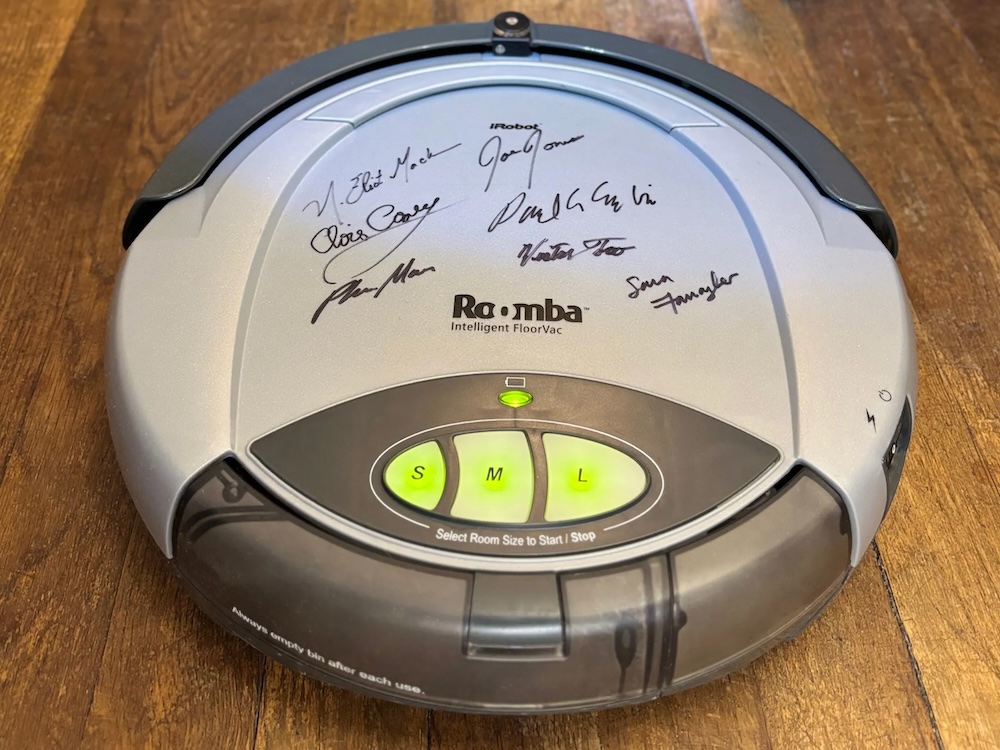
iRobot developers signed this first-generation Roomba Intelligent Floorvac. | Credit: Joe Jones
Few companies have done more for robotics than iRobot since its founding in 1990. iRobot has been the household name in consumer robotics, putting more than 50 million Roomba robot vacuums into homes around the world. The Roomba brought robots out of the lab and into millions of homes, sparking curiosity, comfort, and even affection for machines.
iRobot’s PackBots have been used to keep U.S. military personnel safe by identifying and disposing of improvised explosive devices (IEDs), exploring caves and bunkers in Afghanistan and Iraq, and assisting in urban combat scenarios. PackBots were also used to explore the World Trade Center collapse after 9/11 and the Fukushima nuclear disaster in Japan.
iRobot also made a lasting impact on STEM education with its Create platform and Root educational robot. I have great memories of my 11-year-old daughter coding with the Root robot when she was younger. These products helped inspire the next generation of roboticists and engineers.
Beyond its robots, iRobot alumni have gone on to do great things across the robotics industry and others.
Now, iRobot is in major financial trouble. The company that once defined consumer robotics is drowning in debt, battered by cheap competitors, geopolitical issues, and a failed acquisition by Amazon that regulators killed. The company said last week that it “may be forced to significantly curtail or cease operations and would likely seek bankruptcy protection” if it can’t find additional sources of capital.
Saving iRobot might not make financial sense. But given how much money is being poured into humanoids for the home, cleaning up this iRobot mess is hardly the worst bet.
I’m reading Joe Jones’ book Dancing with Roomba. Jones and others at iRobot pushed incredibly hard to create the original Roomba, succeeding where many others had failed. Even today, modern roboticists can learn many lessons from the early days of the Roomba and iRobot. The company was relentless at the start, doing anything necessary to ship robots. It pivoted its business many times. It faced repeated skepticism, funding challenges and technical hurdles. It withstood long development cycles and invented new technologies to solve a real customer pain point.
After going public on the back of the Roomba’s huge success, iRobot traded in its earlier relentlessness for caution and never found the next Roomba. It shelved a robot lawnmower after 15-plus years of R&D, undersold its military robotics division, and had other failed products.
Did you know: Quiet Logistics is a 3PL that used the Kiva Systems mobile robots. Quiet reached out to iRobot after Amazon pulled the Kiva robots off the market after acquiring the brand in 2012. Quiet Logistics had an idea for a robot it wanted iRobot to build. Bruce Welty, co-founder of Quiet Logistics, told us iRobot never responded to his outreach. The robot he wanted iRobot to build turned into Locus Robotics’ LocusBot, which recently surpassed 6 billion customer picks.
Nonetheless, iRobot’s decline these last couple of years has been tough to watch. Sure, buying iRobot right now might not look attractive on a spreadsheet. The balance sheet is ugly. The margins are thin. Revenue is declining (it made $681.85 million in 2024, a 23.44% decrease from 2023). But some companies are too foundational to let fail. Saving iRobot isn’t about saving a product line. It’s about saving a legacy.
The robotics industry needs more iconic companies. And many iconic companies weren’t always financially stable. Apple nearly went bankrupt in 1997; Tesla faced financial trouble before its government loan; auto and airline companies have been bailed out multiple times; Marvel filed for bankruptcy in 1996; and Nintendo was near ruin before pivoting to video games in the ‘70s. There are countless examples of companies in situations like iRobot’s being saved.
iRobot has also become a pop culture staple, appearing on shows like The Office, Parks and Recreation, Modern Family, The Simpsons, and Saturday Night Live. It’s featured in countless memes and viral videos, and people have even named their Roombas.
iRobot isn’t just another struggling company. It’s a pillar of the robotics industry. Letting it disappear would be a loss far bigger than its current financial situation. Will anyone step up and save iRobot? Let’s give it a second chance to return to its relentless roots and once again pave the way for robotics.


With that big of an infrastructure, for that long, seems like there’s a lot of potential for a solid company with high margins.
– You probably need new executives to coach, mentor and direct the old timers.
– Need fresh director(s?) of technology, manufacturing and service …
And technology director be on the marketing and sales team.
Need a new director of operations.
– Product areas are where robots shouldn’t go: grass cutting, leaves, ice & snow, pool cleaning… etc.
– military: Drones, ground and nautical assignments …
The majority of the product designs can use the same modules: same sensors, actuators, and controls.
The tools, and firmware would be unique.
At the very least, you should put me on the steering committee, to have an experienced with fresh face.
Blame the US government for killing the Amazon deal which ultimately sealed the fate of iRobot.
At this point – a Chinese company should buy all their assets prior to its bankruptcy and throw it away.
This is why US Government shouldn’t be allowed to mettle in technology companies.
The U.S. Govt totally killed this one. Could have been a good acquisition for an American owned company to continue the development. The military products of iRobot was spun off years ago to private equity and then sold to Flir, and now Teledyne. For someone to invest in iRobot now, the debt is very high, so going Chapt 11 would potentially wipe that out and make a better deal to purchase. Taking on all the debt was a mistake and poor management by current C suite. Definitely some good opportunities for the right partner. Unfortunately, all the current products were made in China and dealing with cost increases due to tariffs.
ex-iRobot engineer: iRobot was in decline long before the Amazon purchase attempt. It started with the incredulous attitude regarding competition catching up technology and feature wise and the stubborn resistance to developing and using new technologies themselves. Engineers wanted to, but management didn’t. All new tech development was killed. Ironic because iRobot wants customers to adopt new technologies in their home, but internally insisted on sticking with what they already have and make small changes. I believe it started with hiring top management from regular appliance development, distribution and sales. Goal was to spread to other markets, but side effect was the killing of the future. Should have been a more diversified mix. Also a stronger CEO would have helped with keeping people in line.
With the current unstable government in place, no one wants to buy an American company today.